
Classic New England Clam Chowder With Shell-On Littlenecks and Homemade Broth
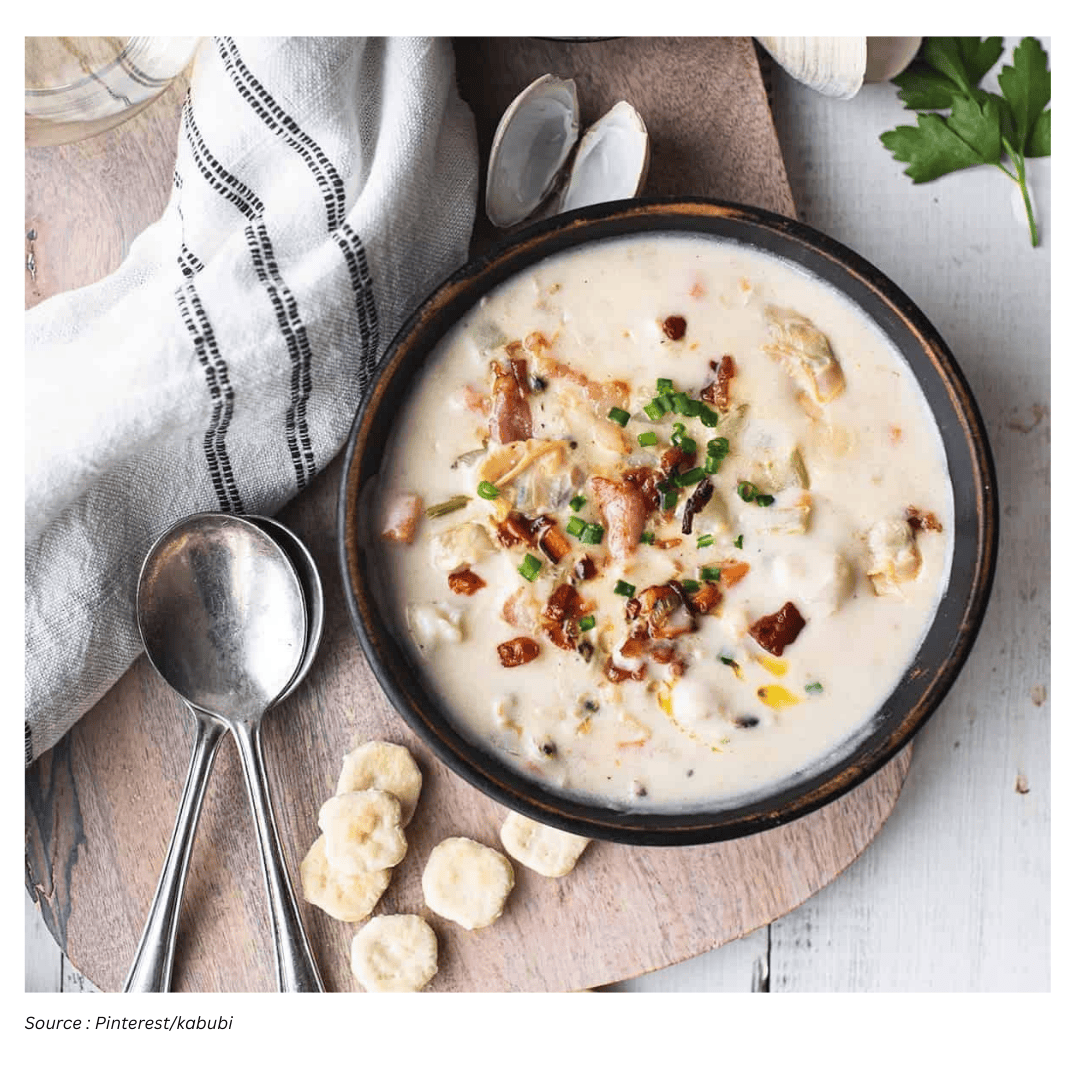
A chowder with history—and a practical reason to make your own broth
New England clam chowder has been evolving for centuries. Its earliest roots trace back to shellfish soups made by indigenous Americans, long before the dish became a staple of coastal New England. Over time, European settlers shaped what many diners now recognize as “classic” chowder: ship’s biscuits were used as a thickener, and the name itself may be tied to a cooking pot called a chaudière or to “jowter,” a 16th-century word for fishmonger. As the dish developed, dairy products such as cream and butter gradually replaced bread as the primary thickening element, and by the 19th century potatoes had joined the mix.
That long arc of change helps explain why “classic” can still leave room for personal preference. Recipe developer Patterson Watkins leans into the qualities people seek in a bowl of chowder—richness, warmth, and a cozy, satisfying heft—while making one choice that has a big impact on flavor: she uses whole littleneck clams and builds a homemade clam broth from their steaming liquid. In her view, the clams should do double duty: they are both the star ingredient and the foundation of the stock.
What makes this version stand out
This chowder checks the familiar boxes: it’s creamy, it includes potatoes, and it uses aromatic vegetables like onion and celery. But it also includes a few decisions that distinguish it from many everyday versions.
- Shell-on clams for flavor and presentation: While many chowders use shucked, chopped clams, keeping littlenecks in their shells adds visual interest and helps extract flavor into the cooking liquid.
- A broth made from steamed clams: Instead of relying solely on packaged clam juice, the recipe captures the clams’ cooking liquid, strains it carefully, and uses it as part of the chowder base.
- Bacon as the pork component: Some New England chowders are made with salt pork, but bacon is used here as a more common kitchen staple.
- Fennel in the aromatic base: Fennel is not always considered traditional in New England clam chowder, but it is included here alongside onion and celery for added nuance.
- Thyme as the herb note: A bay leaf is more typical in many recipes, but this one uses thyme (with the option to add a bay leaf if you like).
Soup vs. chowder: the simplest way to think about it
Trying to draw a hard line between soup and chowder can be an unhelpful exercise. A chowder is best understood as a type of soup—one defined by chunky ingredients. Many chowders are creamy, but not all. The best-known contrast is between New England clam chowder (with dairy) and Manhattan clam chowder (tomato-based, no dairy). Other regional styles include Rhode Island clam chowder with a clear broth and Long Island clam chowder, which includes both tomatoes and cream.
Clams may be the most famous chowder ingredient, but they’re not the only option. Chowders can feature mussels, scallops, fish, or oysters. Oyster chowder, for example, typically includes potatoes and vegetables along with a pork product such as bacon—one reason it’s distinct from oyster stew. There are also vegetable-forward versions like corn chowder and potato chowder, as well as chicken chowder.
Ingredients you’ll need
This recipe is built in two stages: first you steam the clams to create a fresh broth, then you use that broth to make the creamy chowder.
- For steaming the clams and building broth: littleneck clams, water, onion, fennel, celery, salt, black peppercorns
- For the chowder: bacon, butter, onion, celery, fennel, garlic, flour, chicken broth, heavy cream, clam broth (from steaming), hot sauce, Worcestershire sauce, red potatoes, parsley, thyme
Step-by-step: classic New England clam chowder
The process is straightforward, but it rewards attention to the broth. A careful strain keeps the finished chowder clean and pleasant on the palate.
1) Clean the clams. Rinse the clams in cold water and scrub them to remove any dirt or sand.
2) Steam the clams and build the broth. Place the cleaned clams in a large pot and cover with water. Add onion, fennel, celery, salt, and black peppercorns. Stir to combine and bring to a boil over high heat.
3) Cook just until the clams open. Once boiling, reduce the heat to low and cook for 5 to 10 minutes, or until the clams have opened. Discard any clams that do not open. Remove the cooked clams from the pot and set aside.
4) Strain the broth—twice. Strain the broth through a fine mesh strainer, discarding the vegetables and peppercorns. Then strain the broth a second time through paper towels or a coffee filter. Set aside.
5) Cook the bacon. In another large pot or Dutch oven, cook the bacon over medium heat until crisp, about 3 minutes. Remove the bacon with a slotted spoon and set it aside to drain on paper towels.
6) Sauté the aromatics in butter. Add butter to the pot. Once melted, add diced onion, celery, fennel, and garlic. Stir and sauté for about 3 minutes, until tender-crisp.
7) Make a quick roux. Sprinkle the vegetables with flour and stir to combine. Cook for 1 minute more.
8) Build the chowder base. Add chicken broth, heavy cream, and 3 cups of the clam broth. Stir to combine.
9) Season and simmer. Season with hot sauce and Worcestershire sauce, stir, and bring to a simmer.
10) Cook the potatoes and thyme. Add red potatoes and a thyme sprig. Stir and cook, stirring occasionally, until the potatoes are tender—about 15 to 20 minutes.
11) Return the clams to warm through. Add the cooked clams back to the pot and gently stir. Cook for 1 to 2 minutes, just until reheated. Season to taste with salt and pepper.
12) Serve with bacon and herbs. Divide the chowder between bowls and top with parsley, thyme, and the cooked bacon.
Why the double-strain matters
When you steam clams, the cooking liquid captures their flavor—along with any fine sediment that may have slipped through cleaning. Straining once through a fine mesh removes larger solids like the aromatics and peppercorns. The second strain through paper towels or a coffee filter is a more meticulous step that helps catch finer particles, resulting in a clearer, cleaner-tasting clam broth for the finished chowder.
Choosing clams: littlenecks, cherrystones, and other options
If you want to serve the chowder with shell-on clams, littlenecks are the first choice in this approach. If you need an alternative with a similar look and structure, cherrystones are the closest substitute: similarly sized and with hard shells that hold up during cooking.
Steamer clams are a different story. Their softer shells may break apart while cooking, which is not only less appealing visually but can pose a risk to diners. They can still be used for chowder, but they should be cooked separately and removed from their shells before being added to the soup.
Larger clams such as quahogs also require a different handling. They should be steamed separately, removed from the shell, and chopped into smaller pieces before being added, rather than being left whole in the finished bowl.
If you don’t have fresh clams
Fresh clams are central to the homemade-broth approach, but the recipe notes practical alternatives. Frozen or canned clams can be used when fresh clams aren’t available or when you want to reduce prep. Some canned clams come pre-chopped, which can lead to smaller pieces dispersed throughout the chowder. That can be a plus for even distribution, though it may change the balance of “chunky” elements—one reason you might consider dicing the potatoes smaller to match.
To bolster clam flavor when you aren’t making broth from steamed clams, bottled clam juice can be used to enhance the broth component.
Notes on the flavor profile
At its core, this chowder is built on a few classic ideas: pork for savory depth (bacon here), a flour-thickened base, potatoes for body, and dairy for richness. The aromatic mix of onion and celery is familiar, while fennel adds a slightly different accent. The seasoning touches—hot sauce and Worcestershire sauce—are included in small amounts to round out the base rather than dominate it, and thyme provides an herbal backbone (with bay leaf offered as an optional addition if you prefer that traditional note).
The final bowl is meant to feel substantial: a creamy soup with chunky potatoes and clams, finished with crisp bacon and fresh herbs. Served hot, it leans into the very qualities that have kept New England clam chowder in rotation for generations—comfort, richness, and a sense of place—while using a homemade clam broth to keep the flavor vivid and fresh.