
Pizza’s Long Road: From Ancient Flatbreads to the Modern Pizzeria
A dish that feels ancient—because its building blocks are
Pizza inspires a particular kind of devotion: it is easy to love, easy to share, and endlessly adaptable. Yet the pizza most people picture today—leavened dough, baked hot and fast, topped with a familiar set of ingredients—arrived relatively late in the long timeline of human food. What is ancient is the foundation: flatbread. If pizza is, at heart, bread plus toppings plus heat, then its prehistory begins thousands of years before anyone wrote down the word “pizza.”
Archaeological evidence underscores just how deep those roots go. At the Shubayqa 1 site in the Black Desert of northeast Jordan, a team from the University of Copenhagen and University College London found charred remains of flatbread dated to an astonishing 14,400 years old. The lead author of the published research drew a striking conclusion: bread pre-dates agriculture by at least 4,000 years in the Levant, forcing a rethink of how bread-making relates to the origins of agriculture. This is not pizza in any modern sense, but it does show that the basic idea—grain turned into dough, cooked into bread—has been part of human life for an extremely long time.
Proto-pizzas: toppings, aromatics, and the temptation to draw a straight line
Once flatbread exists, it is not hard to imagine it being dressed with whatever is available: oil, herbs, vegetables, perhaps cheese. That temptation—to see pizza everywhere in the past—runs through many stories about the dish. Some examples are compelling stepping stones; others are more like wishful thinking.
Ancient Egypt offers an especially suggestive case. Flatbread was a staple of the Egyptian diet, and evidence indicates it was being made at least 5,000 years ago. Tomb paintings and records suggest bread was eaten with toppings such as onions and garlic, and possibly even cheese. The combination is “tantalisingly close” to what later generations would recognize as a topped bread. Even the ancient commentary around bread-making has its own intrigue. Herodotus (c. 484–425 BCE) wrote that Egyptians ate bread made from spelt (emmer) and that it was kneaded with their feet. The account is memorable, but it is also doubtful: paintings show Egyptians kneading dough with their hands, suggesting Herodotus embellished or misunderstood what he reported.
Elsewhere, flatbread served not just as food but as a tool. For thousands of years—well into the late Middle Ages in Europe—flatbreads were used instead of plates. Cooked food was placed on them; the bread soaked up juices and sauces and was eaten at the end. Calling this “pizza” would be a stretch, but it does establish an enduring habit: bread as a base for other foods.
Even literature gets pulled into the story. In Virgil’s Aeneid (c. 29 BCE), a prophecy foretells the Trojans will not find peace until hunger forces them to eat their tables. In Book VII, Aeneas and his men prepare flatbreads topped with cooked vegetables, then realize they are eating their “tables,” fulfilling the prophecy. The scene is not a recipe, but it reflects how natural it was to combine bread with toppings—enough that later readers can’t help but see echoes of pizza.
Claims worth questioning: shields, soldiers, and convenient origin stories
Not every popular origin tale stands up to scrutiny. A number of online accounts claim Persian soldiers under Darius the Great (c. 550–486 BCE) baked flatbreads on heated shields, sometimes with cheese and dates on top. The problem is evidence: no even vaguely contemporaneous sources are offered to support it, and the story appears to be a later invention. It is a useful reminder that pizza’s history is often told with enthusiasm first and documentation second.
Rome’s contribution: a cheese bread that looks familiar
Ancient Rome, however, provides something more concrete: written evidence of baking and recipes that resemble a close cousin of pizza. In On Agriculture (c. 160 BCE), Marcus Cato recorded a recipe for libum, a cheese loaf baked slowly on a warm hearth under a crock. The ingredients are straightforward—cheese, flour, and egg—and the method is clearly described. It is not a topped flatbread, but it sits in the same family of ideas: grain and dairy combined into a baked staple, made to be satisfying and shareable.
When does “pizza” begin? A word, a document, and a long gap
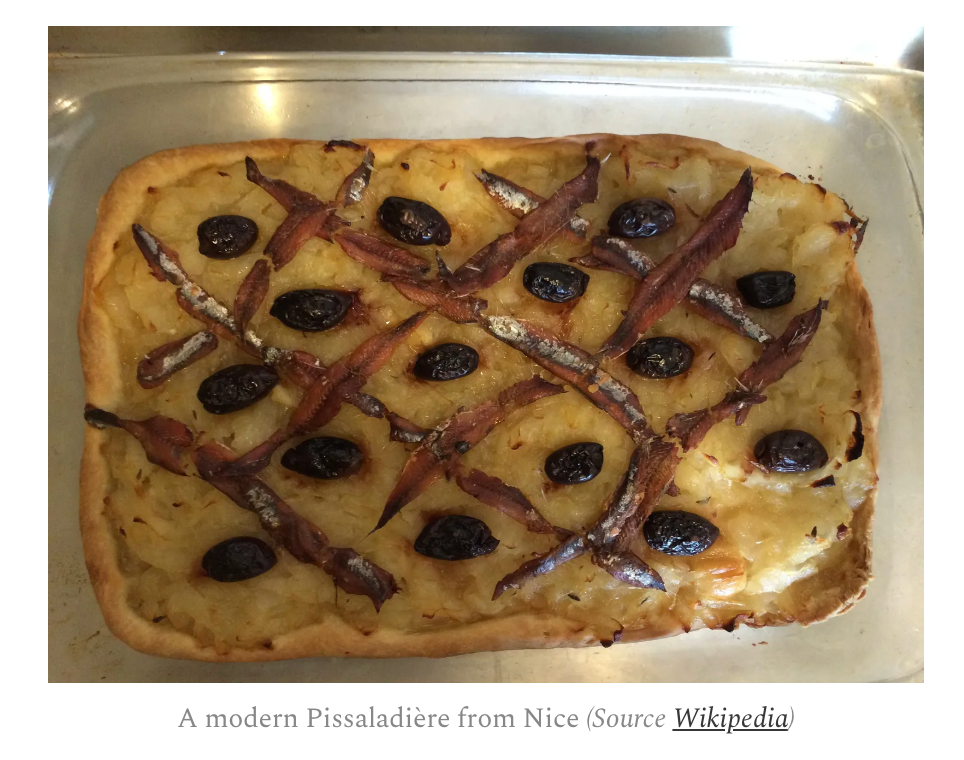
Pinpointing the birth of pizza “as we know it” is surprisingly difficult. The honest answer is that we do not know for sure. One of the earliest recipes resembling modern pizza does not even come from Italy. A document from Provence dated 879 describes a Pissaladière: leavened flatbread topped with onions, olives, and anchovies. The toppings are familiar, the structure is familiar, and yet it sits outside Italy—an early sign that the broader Mediterranean world shared techniques and tastes that could converge into something pizza-like.
The word “pizza” itself appears in a record more than 1,000 years old. In 997, a charter from the town of Gaeta in southern Italy includes the phrase duodecim pizze—twelve pizzas—listed as part of a rental payment to the local bishop, alongside coins paid on specific feast days. It is a wonderfully practical appearance: pizza not as a romantic symbol but as an item of obligation. The mention has even prompted a playful thought that the first recorded “pizza” also hints at the first “pizza delivery,” though the reality is more mundane: a payment in kind. Importantly, this still was not pizza in the modern sense. It was likely a focaccia-type bread: proved and risen, but otherwise different from the Neapolitan standard that would later define the category.
Focaccia, halfway houses, and regional names
Language and regional cooking often blur the lines between breads. Benedetto di Falco, writing in 1535 about Neapolitan cuisine, stated that “Focaccia in Neapolitan is called pizza.” That single sentence captures an important point: for a long time, “pizza” could refer to breads that modern diners would classify differently.
In Liguria, a dish known as sardenaira was eaten around the same period. Often called pizza all’Andrea after Admiral Andrea Doria (1466–1560), it was topped with olive oil, garlic, anchovies, and capers. Again, it sits between focaccia and modern pizza—close enough to be part of the story, but not quite the final form.
Naples in the 18th century: the conditions that shaped modern pizza
To find truly modern pizza, the story turns to Naples in the 18th century. The city was a bustling port with a largely working-class population living in cramped buildings that often lacked cooking facilities. In that environment, cheap food that could be eaten on the move mattered. Pizza fit the need: filling, fast, and flexible.
A detailed glimpse of Neapolitan pizza culture appears in a 1789 work titled Collezione di tutti i poemi in lingua Napoletena. Despite its title, it reads more like an elaborate dictionary, and it lists a wide range of pizza-type items under the generic name Pizzella. The list includes fried pizza, oven pizza, and numerous named variations such as pizza di ricotta and pizza rustica, among others. The text also offers an etymological explanation, suggesting a link to Latin terms related to stirring dough and to the idea of dough being “crushed” or pressed by hand—an image that resonates with the physical act of shaping a pizza base.
Notably, the same passage remarks that monasteries of nuns were “illustrious” for some preparations, yet it declines to preserve full recipes. The author even comments—somewhat dismissively—that cooking is part of chemistry and belongs to the “most simple sciences,” implying it was not appropriate to include detailed methods in a vocabulary focused on names rather than things. For anyone hungry for historical recipes, it is a frustrating near-miss.
Pizza observed: Alexandre Dumas and the economics of a slice
By the 19th century, pizza had become visible enough to attract the attention of visiting writers. Alexandre Dumas (1802–1870) traveled to Naples in 1835 and left one of the most vivid first-hand accounts. He argued that the Neapolitan of the lower class was not necessarily wretched, because desires and necessities were aligned—and what did he wish to eat? A pizza.
Dumas described pizza in terms of price and practicality: a pizza of two farthings could feed one person, while a pizza of two sous could satisfy a whole family. He also emphasized that pizza, though it might appear simple at first glance, was “compound,” listing versions prepared with bacon, lard, cheese, tomatoes, and fish.
Perhaps his most revealing observation was economic. Dumas called pizza “the gastronomic thermometer of the market,” explaining that prices rose and fell with the abundance or scarcity of ingredients. A fish pizza selling cheaply implied good fishing; an oil pizza becoming more expensive implied a bad olive yield. He added another factor: freshness. Yesterday’s pizza did not command today’s price, and for small purses there was even pizza a week old—less agreeable, perhaps, but a practical substitute for sea-biscuit.
Pizza in English print: technique, timing, and a harsh verdict on hygiene
The earliest reference found here to pizza in an English newspaper comes from the London Morning Post on 22 December 1860. The report frames pizza as a favorite Neapolitan delicacy with a specific rhythm: it was made and eaten between sunset and two or three in the morning, it had to be baked in five minutes, and it needed to be served immediately—“piping hot”—or it was not worth a grano.
The same piece provides a detailed description of preparation. The baker takes a ball of dough, kneads and spreads it with the palm to about half the thickness of a muffin, then adds mozzarella (described as rich cream beaten almost like a cream cheese), grated cheese, herbs, and tomato. The cake goes into the oven for five minutes and is served as hot as possible, with the cheeses melted and united with herbs and tomato. The outside crust, the report insists, must have a certain “orthodox crispness.”
Beyond technique, the article suggests pizza had become a social leveller in Naples. Rich and poor congregated in pizza shops; aristocrats could be seen eating alongside coachmen, valets, and barbers. Yet the correspondent also delivered a blunt assessment of hygiene: “The pizza shops are about the filthiest in Naples,” located in mean alleys and disreputable quarters. Even so, they were thronged. The contradiction is telling: popularity did not depend on refinement, and the demand for pizza overrode discomfort with its surroundings.
Street selling and staying warm: a practical solution
Early Neapolitan pizza selling was not limited to shops. Sellers would bake pizzas in wood-fired ovens and then take them out onto the street. That created a simple problem: how to keep pizza warm while moving through the city. One account suggests they coiled wet towels on their heads, balanced a small coal stove on top, and stashed the pizza above the stove. The image is striking—pizza as literal street food, carried through the city with improvised heat management.
The pizzeria as a destination: Port’Alba and a new way to pay
Over time, pizza transitioned into a more refined food eaten sitting down, and one establishment stands out in that shift: Antica Pizzeria Port’Alba in Naples. It began as a food stand in 1738 and, in 1830, opened what is generally considered the world’s first pizzeria. Its ovens were lined with lava rocks from Mount Vesuvius—a detail that anchors the restaurant in its local landscape and craft.
Port’Alba also became a hang-out for students and intellectuals, groups not known for having much cash. To accommodate them, a payment system called pizza an otto allowed customers to pay up to eight days after their meal. The arrangement even inspired jokes that one could get a last meal for free if one died before the eight days were up. The restaurant remains open today, a living link to the era when the pizzeria became a social space rather than just a point of sale.
Across the Atlantic: immigration, home cooking, and New York’s early shops
Italian immigrants brought pizza to America during the 19th century. For decades, they made it at home before similar establishments appeared. The pioneering figure in the early American pizzeria story, as presented here, is Filippo Milone, who likely arrived in the United States in 1892. In 1898, he opened a bakery-and-grocer at 53½ Spring Street in New York and began selling pizzas not long afterward. He went on to establish five more restaurants in the city, helping to build the commercial foundations of pizza in America.
Yet the credit for “first” has often shifted elsewhere. Milone’s role has been “airbrushed” from history in favor of one of his staff members, Gennaro Lombardi. Lombardi, born in Italy in 1887, arrived in New York in November 1904 and began working at 53½ Spring Street shortly afterward. He appears to have acquired the business in 1908. Renamed “Lombardi’s” in 1939, it has been claimed as the first pizza restaurant in the United States—though the story here emphasizes that Lombardi did not found it.
Milone’s personal ending is stark: he died childless in 1920 and is buried in an unmarked grave in Queens, his contributions largely forgotten. Even so, his role mattered. The narrative connects his work to the scale of pizza today, describing a global business exceeding $150 billion a year in sales.
There is also an important footnote to the “first pizzeria” debate in New York. Giovanni Albano founded a pizzeria at 59½ Mulberry Street in 1894, earlier than Milone’s 1898 opening. However, Albano did not expand the way Milone did, and so he is sometimes excluded from the main storyline when the focus is on growth and influence rather than chronology alone.
What pizza’s history really shows
Pizza’s story is not a single invention moment but a gradual convergence: ancient flatbreads, the habit of eating food on bread, regional breads that carried the name “pizza,” and finally the specific urban pressures of Naples that shaped a fast, affordable, hot-baked meal. The written record captures pizza in many roles—rent payment, street commodity, market indicator, social leveller—and also preserves the opinions of outsiders, from admiration of technique to disdain for shop cleanliness.
For cooks and diners today, that history offers a grounded kind of romance. Pizza is not just a timeless comfort food; it is a practical solution that became a tradition, then a business, then a global habit—still, at its core, bread with something on it, cooked and shared.
Key moments and details mentioned in the record
- 14,400-year-old flatbread remains found at Shubayqa 1 in northeast Jordan, suggesting bread predates agriculture by at least 4,000 years in the Levant.
- Ancient Egyptian flatbreads (at least 5,000 years old) were eaten with toppings such as onions and garlic, and possibly cheese; Herodotus’ claim about kneading with feet is likely inaccurate.
- Flatbreads were used as plates in Europe for centuries; Virgil’s Aeneid includes a scene of eating “tables” made of flatbread topped with vegetables.
- Unsubstantiated tale: Persian soldiers under Darius the Great baking flatbread on shields with toppings.
- Marcus Cato’s libum recipe (c. 160 BCE) documents a cheese bread baked on a hearth.
- 879: a Provençal document describes Pissaladière, a leavened flatbread with onions, olives, and anchovies.
- 997: the word “pizza” appears in a Gaeta charter as part of a rental payment to a bishop.
- 1535: Benedetto di Falco notes that Neapolitans called focaccia “pizza.”
- 18th-century Naples: pizza develops as cheap, portable food for a working population.
- 1835: Alexandre Dumas describes pizza’s ingredients, pricing, and how freshness affects cost.
- 1860: an English newspaper describes five-minute baking, immediate service, and “orthodox crispness,” while criticizing the hygiene of pizza shops.
- 1738/1830: Port’Alba evolves from a stand to a sit-down pizzeria with lava-rock-lined ovens; introduces pizza an otto (pay within eight days).
- 1898: Filippo Milone opens at 53½ Spring Street, New York, and expands to multiple restaurants; later narratives often credit Gennaro Lombardi, who arrived in 1904 and acquired the business in 1908.
- 1894: Giovanni Albano founded a pizzeria at 59½ Mulberry Street but did not expand similarly.